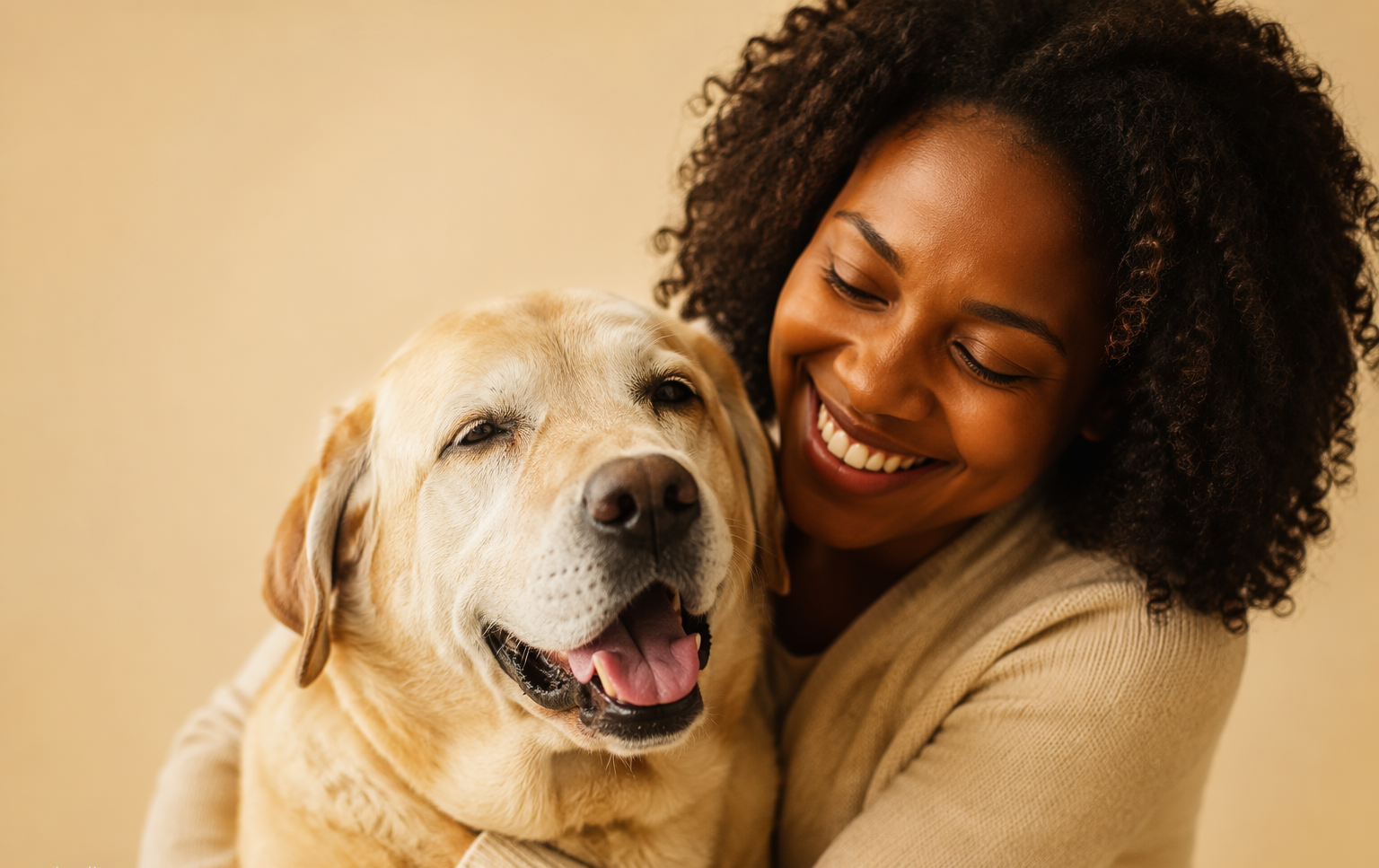
Why pet aging is suddenly a science
Age is the single greatest risk factor for the diseases that take our dogs — cancer, heart disease, kidney failure, cognitive decline. For decades, veterinary medicine treated each disease as it arrived. The new approach asks a more radical question: what if you could slow the aging process itself, and push all of those diseases back at once?
Dogs turn out to be nearly ideal subjects for this science. Unlike lab mice, they share our homes, our environment, our medical system and many of our age-related diseases — which makes canine aging research doubly valuable: it helps dogs directly, and it is one of the best windows into human aging we have.[1]
The Dog Aging Project: 45,000 dogs and counting
The Dog Aging Project, run out of the University of Washington and Texas A&M with NIH funding, is the largest study of canine aging ever attempted: more than 45,000 dogs enrolled by their owners across the United States, contributing veterinary records, DNA, annual health surveys and — for a subset — blood samples tracked over years.[2]
Its premise is simple and powerful: watch tens of thousands of real dogs age in real homes, and the patterns emerge — which breeds decline fastest, which diets and environments correlate with healthy years, which blood markers predict disease before symptoms. The project publishes openly, so its dataset is becoming the shared foundation for everyone else in this article.
What this means for your dog
The longevity pipeline is real but years from your vet's shelf. The proven longevity interventions for your dog today are unglamorous and free-ish: lean body condition (the single biggest lifespan lever ever demonstrated in dogs), dental care, twice-yearly senior checkups with bloodwork after age seven, and daily movement. The science below is the future; those four habits are the present.
Rapamycin and the TRIAD trial
Rapamycin is the most credible longevity drug candidate in mammals: it reliably extends lifespan in mice and acts on mTOR, a master cellular switch for growth-versus-maintenance. In 2017, a small pilot trial gave 24 healthy middle-aged companion dogs low-dose rapamycin or placebo for ten weeks. The result: no clinical side effects, and echocardiography suggested improved measures of age-related heart function in the treated dogs.[3]
That pilot became the rationale for TRIAD — Test of Rapamycin in Aging Dogs — the Dog Aging Project's randomized, placebo-controlled trial of rapamycin in hundreds of older dogs, designed to answer the only question that matters: do treated dogs actually get more healthy years?[2] Results will take years; dogs, unlike mice, insist on living at dog speed. But for the first time, the experiment is properly designed.
Loyal's STAY trial and the FDA conditional-approval path
Biotech company Loyal is attempting something bolder: not just studying aging, but getting a longevity drug approved. Its STAY study enrolled roughly 1,300 senior dogs across more than 70 US veterinary practices — the largest veterinary clinical trial in history — testing its lead candidate LOY-002 against placebo in everyday senior dogs.[4]
Here is the regulatory mechanism owners should understand, because it will shape what reaches your vet. The FDA offers animal drugs a conditional approval pathway (XCA) for serious conditions with unmet need. A company must clear three bars: a Reasonable Expectation of Effectiveness (RXE), a safety package, and manufacturing quality. Loyal announced that the FDA accepted LOY-002's RXE package in 2025 and its safety package thereafter — with safety data from over 400 treated dogs — leaving manufacturing as the final element before possible conditional approval, which would allow marketing while the full efficacy dataset matures.[5]
Translation for owners: conditional approval does not mean "proven to extend life" — it means the FDA agrees the drug is safe and reasonably likely to work, with final proof due within the conditional window. It is a genuinely rigorous pathway, and LOY-002 would be the first drug ever approved anywhere to extend healthy lifespan in any species.
On the horizon: GLP-1 drugs for pets
The drug class that transformed human weight management is coming for the pet bowl. Roughly 60% of US dogs and cats are overweight — the single most treatable driver of shortened pet lifespan — and in December 2025 Okava Pharmaceuticals dosed the first cat in MEOW-1, a clinical trial of OKV-119, an implant that releases a GLP-1 medicine continuously for up to six months. It is the first GLP-1 weight-loss trial ever run in cats or dogs, conducted under an FDA Investigational New Animal Drug application, with a canine version in development.[6] A second program at Cornell is testing a weekly GLP-1 injection in overweight cats.
Caveats apply: these are early trials in overweight cats, not longevity drugs, and nobody should ever give a human GLP-1 pen to a pet. But the direction is unmistakable — pet medicine is adopting the most important drug classes in human medicine, a decade behind and catching up fast.
What this means for South African pet owners
None of these trials enrols South African dogs, and FDA-conditional products would take years to reach SAHPRA registration. But the science belongs to everyone: the Dog Aging Project's open findings on diet, weight and healthy aging apply equally to a Boerboel in Bloemfontein as to a beagle in Boston.
PSA PETS is built on this exact thesis — that the pet longevity wave will reach South Africa, and owners here deserve the compounds with the best evidence, at local prices, with the evidence graded honestly. Our Senior Vitality blend is in development around canine aging research; meanwhile, the single most proven longevity "supplement" remains keeping your dog lean — no waitlist required.
Honest answers.
What is the Dog Aging Project?
The largest canine aging study ever run: an NIH-funded research program at the University of Washington and Texas A&M with 45,000+ enrolled companion dogs contributing health records, DNA and annual surveys, designed to understand how dogs age and how to extend their healthy years. It also runs the TRIAD rapamycin trial.
Does rapamycin really extend dog lifespan?
Not proven yet. A 2017 pilot in 24 middle-aged dogs found low-dose rapamycin was well tolerated and suggested improved heart function measures. The larger TRIAD randomized controlled trial is now testing whether it actually extends healthy lifespan in older dogs. Never give your dog rapamycin outside a clinical trial — it is a prescription drug with real risks at the wrong dose.
What is Loyal's LOY-002 and when will it be available?
LOY-002 is a daily pill in development to extend healthy lifespan in senior dogs, tested against placebo in the 1,300-dog STAY trial. The FDA has accepted its Reasonable Expectation of Effectiveness and safety packages under the conditional approval pathway. Conditional approval would make it the first lifespan drug approved in any species — but it is still not "proven to extend life," and availability outside the US would take longer.
What does FDA conditional approval actually mean?
It is a US pathway (XCA) for animal drugs addressing serious unmet needs: the company must show safety, manufacturing quality and a reasonable expectation of effectiveness, then may market the drug while full efficacy proof is completed. Rigorous — but short of full approval.
Are GLP-1 "pet Ozempic" drugs available?
Not yet. The first trial (Okava's MEOW-1, a six-month GLP-1 implant in ~50 overweight cats) dosed its first cat in December 2025; a weekly-injection trial is running at Cornell. Results are expected from mid-2026. Never administer human GLP-1 medicines to pets — dosing and safety in animals are unestablished.
What can I do today to help my dog live longer?
The proven four: keep your dog lean (lean dogs in the landmark Purina study lived meaningfully longer), maintain dental health, book twice-yearly vet checks with bloodwork from age seven, and keep daily movement going into the senior years. Supplements and future drugs are add-ons to that foundation — never substitutes for it.
References
-
[1]
Urfer SR, Kaeberlein TL, Mailheau S, et al.. “A randomized controlled trial to establish effects of short-term rapamycin treatment in 24 middle-aged companion dogs.” GeroScience, 2017.
https://pmc.ncbi.nlm.nih.gov/articles/PMC5411365/ -
[2]
Dog Aging Project consortium. “The Dog Aging Project — longitudinal study of aging in tens of thousands of companion dogs.” dogagingproject.org, 2026.
https://dogagingproject.org -
[3]
Urfer SR, Kaeberlein M, Promislow DEL, Creevy KE. “Rapamycin in aging dogs (TRIAD) — trial rationale and pilot cardiac outcomes.” GeroScience / PubMed, 2017.
https://pubmed.ncbi.nlm.nih.gov/28374166/ -
[4]
Loyal (Cellular Longevity, Inc.). “The STAY study — LOY-002 clinical trial in ~1,300 senior dogs across 70+ veterinary practices.” loyal.com, 2026.
https://loyal.com -
[5]
Loyal (Cellular Longevity, Inc.). “One step closer to a dog longevity drug: LOY-002's FDA safety milestone (XCA pathway, RXE acceptance).” loyal.com/posts, 2026.
https://loyal.com/posts/loy-002-tas -
[6]
Okava Pharmaceuticals. “OKAVA Announces First Cat Dosed in MEOW-1 Study of OKV-119, the World's First GLP-1 Weight Loss Therapy for Pets.” okava.com (press release), 2025.
https://okava.com/okava-announces-first-cat-dosed-in-meow-1-study-of-okv-119-the-worlds-first-glp-1-weight-loss-therapy-for-pets/